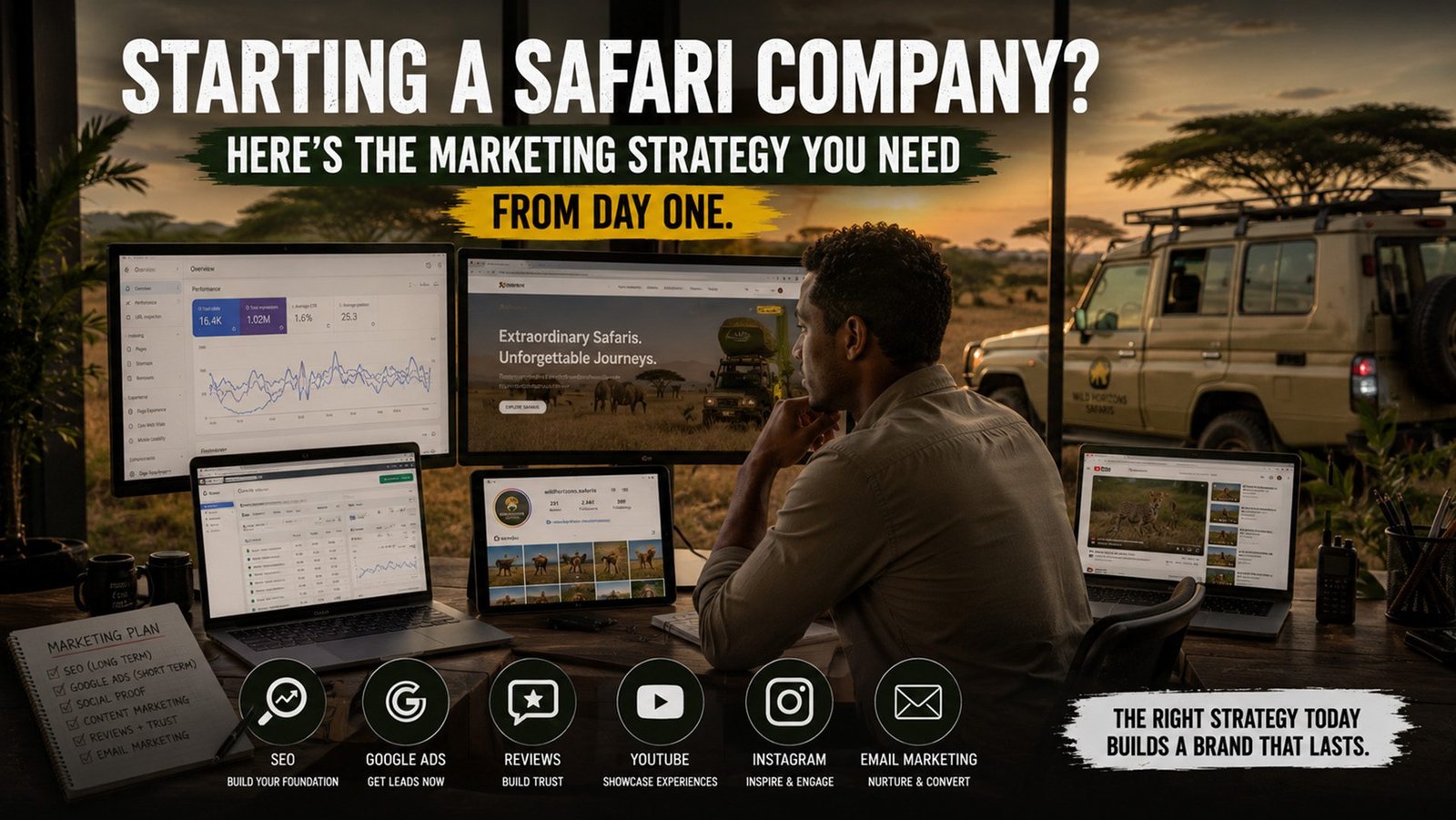
You Just Started a Safari Company. Here Is the Exact Digital Marketing Strategy You Need From Day One.
Starting a safari company is exciting. You have the vehicles, the guides, the routes, maybe even a few contacts from previous work in hospitality or tourism. What you do not have yet is visibility. And in this industry, visibility is everything, because your customer is not walking past your shop on Kenyatta Avenue. They are sitting in Copenhagen or Houston or Sydney, searching on Google, scrolling on Instagram, watching YouTube, and making a decision about who to trust with a trip that might cost them five thousand dollars or more.
This article is for you if you have just opened a safari business, or you are about to, and you want to know where to put your money, what to prioritize, and what a realistic digital marketing budget looks like. I am going to give you a real answer, not a vague one.
Start With SEO. Immediately.
The single most important thing you can do for a new safari business from a digital marketing perspective is start SEO from day one. Not after you get your first few clients. Not after you build the website. From day one.
Here is why the timing matters. SEO is not a tap you turn on and off. It is a foundation you build over time. In a competitive niche like Kenya or Tanzania safaris, you are competing with companies that have been online for ten to fifteen years. They have backlinks from hundreds of travel publications. They have thousands of pages of indexed content. They have reviews going back years. You are not going to overtake them in three months. Realistically, for a new safari brand to start seeing meaningful organic traction, you are looking at twelve to twenty four months of consistent work.
That sounds like a long time. But here is the thing. If you start today, you will be seeing results in a year. If you wait six months to start, you will be seeing results in eighteen months. The clock does not stop while you are deciding.
What SEO actually involves for a new safari company is building a website with the right structure from the beginning, as I have talked about in other articles. Keyword research to identify the terms your potential clients are actually searching for. Content built around those keywords, from destination pages to tour itineraries to informational blog posts that answer the questions people ask before they book. Technical SEO to make sure the site is fast, indexed properly, and structured in a way Google can understand. And link building to build the authority your domain needs to compete.
For a new safari company, a solid SEO retainer will cost you around KES 80,000 per month. That covers strategy, content production, technical maintenance, and link building. It is not cheap. But compare it to what it costs to run ads forever, and you will understand why it is the most important long-term investment you can make.
Google Ads: Your Bridge While SEO Compounds
Because SEO takes time, a new safari company cannot rely on organic traffic alone in the first year or two. You need business coming in while the SEO engine is building. That is where Google Ads comes in.
Google Ads puts you on the first page immediately. You are not waiting for Google to trust your domain. You are paying to appear when someone searches “5 day Masai Mara safari” or “Tanzania family safari package.” The right campaign structure, with properly researched keywords, well written ad copy, and landing pages that are built to convert, will start generating enquiries from day one.
For a new safari company, a monthly Google Ads budget of KES 90,000 to 150,000 is a reasonable starting point. This covers the ad spend and the management. You will not be dominating the market at this level, but you will be getting in front of real buyers and generating leads while your SEO grows in the background.
The two channels work together. SEO builds your long-term asset. Google Ads keeps revenue coming in while it does. Running both from the start is the smartest approach for any new safari business trying to compete in a market this established.
Combined, SEO and Google Ads will cost you roughly KES 170,000 to 230,000 per month. That is your digital foundation.
Social Proof: The Thing That Closes the Deal
Here is something most new safari businesses underestimate. Your potential client is not just going to find you on Google and book. Before they book, they are going to search your company name. They are going to look for reviews. They are going to scroll your Instagram. They are going to check if your Facebook page has real photos of real people on real safaris. They are going to look at your Google Business Profile. They are asking themselves one question: is this company real, and can I trust them with my money?
This is where social proof comes in, and it matters just as much as your search rankings.
From the very first safari you run, you need to be building your review profile. TripAdvisor is essential for the travel and tourism space. Google reviews matter for your Business Profile. After every trip, follow up with your guests and ask them to leave a review. Make it easy for them by sending a direct link. Five genuine reviews from real travellers will do more for your conversion rate than most things you spend money on.
Beyond reviews, you need visual evidence across all your platforms. Photos and short videos of your branded vehicle out on safari with guests inside. Wildlife footage from actual trips. Guests at sunrise on the Mara. Your guide pointing out a lion kill. These should be on your website, your Instagram, your Facebook, and your YouTube channel. This content tells the story that a service page cannot tell. It shows a stranger in another country that you are real, that you operate, and that people who went with you had a great time.
Do not wait until you have a big social media following to start. Start posting from the first trip. The content you create now will still be working for you two years from now.
Social Media Strategy: Presence Across All Platforms
A good social media strategy for a safari company is not just about posting pretty wildlife photos, though those do well. It is about being present everywhere your potential clients might be looking.
People today do not just search on Google. They search on Instagram. They search on TikTok. They ask in Facebook groups. They watch YouTube. A tourist from Germany planning a Kenya trip is in four or five different places at once before they decide who to book with. Your brand needs to show up in as many of those places as possible.
For a new safari company, a professional social media management service will cost you around KES 50,000 per month for genuine strategy and content creation. That means someone who is thinking about your audience, creating content consistently, managing your pages, and growing your presence with intent. Not someone who posts once a week and calls it done.
The return on this investment is not always direct and immediately measurable in the way that Google Ads is. But it builds the brand layer that makes everything else work better. When someone clicks your Google Ad, then searches your brand name and finds a strong Instagram presence with fifty posts of actual safaris, your conversion rate on that ad goes up. Social media is not separate from your SEO and paid strategy. It is what gives those channels credibility.
YouTube: The Biggest Untapped Opportunity in Safari Marketing Right Now
This is the one I am most excited to talk about because the gap in this market is enormous.
When you search for terms like “5 day Kenya safari experience” or “what to expect on a Tanzania safari,” what you find in the video results is mostly travel influencers and bloggers who did a generic trip and recorded it for their personal channels. Their videos rank well. They get views. But those people are not tour operators. They cannot book you a safari. They can only tell you what it was like.
Safari companies have largely not filled this space. Most tour operators in East Africa either have no YouTube channel or have one with a handful of videos that were uploaded years ago and have no keyword strategy behind them.
Here is what a smart new safari company should do. Create video itineraries with professional voiceovers. Not silent wildlife footage, actual narrated videos that walk a potential client through what a five-day Masai Mara safari looks like, day by day. What time you leave Nairobi. What you see on day two in the conservancy. What the camp looks like. What meals are included. What the game drives feel like.
Google now transcribes audio from videos. When you have a voiceover saying “five-day Masai Mara safari departing Nairobi,” Google’s systems can read that audio as text and understand what the video is about. Visual footage of animals is beautiful, but it is the audio and the description that tell Google what to rank your video for. A well-titled, well-described video with proper keyword targeting in the title, the description, and the tags, paired with a clear voiceover, has a genuine shot at ranking for competitive search terms.
And because so few safari companies are doing this properly, you do not need a massive channel to start seeing results. One good video targeting the right keyword, built the right way, can drive enquiries from people who found you on YouTube and not Google at all.
What Your Budget Looks Like
To pull this all together, here is a realistic monthly digital marketing budget for a new safari company that wants to compete seriously:
SEO retainer (strategy, content, technical, link building): KES 80,000
Google Ads management fee: KES 40,000 to 50,000
Google Ads spend (the actual money going to Google): USD 300 to USD 600 per month, based on USD 10 to USD 20 per day. At current rates that is roughly KES 39,000 to KES 78,000 on top of the management fee.
Social media management: KES 50,000
Total: approximately KES 209,000 to KES 258,000 per month, depending on how aggressively you run ads.
That is the honest number. And yes, it is a significant investment for a new business. But before you close the tab, let me walk you through what the Google Ads spend alone should return.
The ROAS Breakdown on Google Ads: Does It Actually Make Sense?
At USD 10 to USD 20 per day in ad spend, a well-managed Google Ads campaign for a safari company in a competitive market should generate roughly 10 to 20 qualified inquiries per month. These are not random clicks. These are people who searched for something like “5 day Masai Mara safari” or “Tanzania private safari package,” saw your ad, and clicked through to your site.
Not every inquiry becomes a booking. For a new safari company that is still building trust and has limited reviews, a realistic inquiry-to-booking conversion rate sits around 15 to 25%. Let us run the numbers on two scenarios.
Conservative scenario: USD 300 ad spend, 10 inquiries, 15% conversion rate. That gives you 1 to 2 bookings. At a modest average safari value of USD 2,000, that is USD 2,000 to USD 4,000 in revenue from USD 300 in spend. That is a ROAS of roughly 7x to 13x on the ad spend alone.
Realistic scenario: USD 600 ad spend, 15 to 20 inquiries, 20% conversion rate. That gives you 3 to 4 bookings. At USD 2,500 average booking value, that is USD 7,500 to USD 10,000 in revenue from USD 600 in spend. ROAS of roughly 12x to 17x.
Better scenario: Same USD 600 spend, but your landing pages are converting well, your reviews are building up, and you are closing at 25%. That is 4 to 5 bookings at USD 2,500 to USD 3,500 average. Revenue of USD 10,000 to USD 17,500. ROAS of 17x to 29x.
Now, these numbers assume average booking values on the conservative side. Safari packages range widely, from USD 1,500 budget group tours to USD 8,000 or more for private luxury itineraries. If your average booking sits at USD 3,500 or higher, even two bookings per month from Google Ads more than justifies the entire digital marketing budget, not just the ad spend.
The math works. But it only works if the campaign is structured properly, the landing pages are built to convert, and someone is actively managing and optimizing the account every month. A badly run Google Ads account in this niche will burn through your budget on irrelevant clicks and produce nothing. The management fee is not optional overhead. It is what makes the ad spend perform.
Start with the right strategy, invest in it properly, and build it consistently from day one. The safari market is competitive, but there is room for new brands that show up the right way. Your potential clients are out there searching right now. The question is whether they are finding you or finding someone else.
If you want to talk through what this strategy looks like specifically for your new safari business, reach out to us at SEO Agency Kenya. We work with safari and tour companies across East Africa and we know exactly what it takes to build a new brand in this space from the ground up.