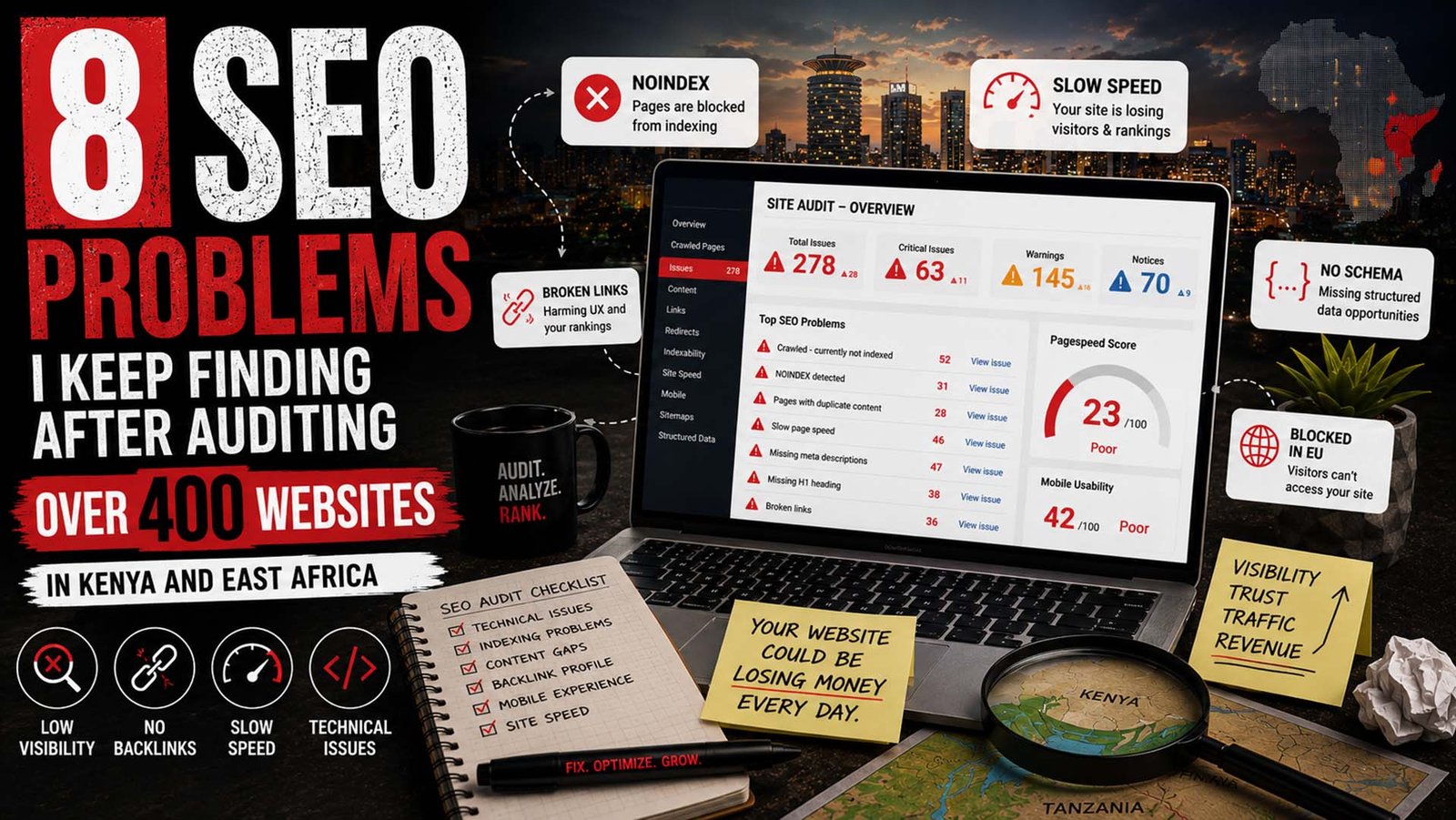
8 SEO Problems I Keep Finding After Auditing Over 400 Websites in Kenya and East Africa
I have done SEO audits on over 400 websites. Safari companies, hotels, law firms, real estate agencies, lighting suppliers, you name it. And I keep finding the same problems across all of them. Some are small and easy to fix. Others are catastrophic. The kind that take a business completely off Google without the owner even knowing.
This article is about those problems, starting from the smaller issues and building up to the ones that cause real damage. If you have a website in Kenya or East Africa, read this carefully because chances are you have at least two or three of these right now.
8. You Are Not Using Social Media as an SEO Asset
Most business owners treat social media as a branding exercise and SEO as a completely separate thing. That gap is costing them visibility in ways they are not even measuring.
I have done SERP analysis on a lot of safari and tourism related keywords, and I keep seeing the same thing. Facebook posts, Instagram reels, and YouTube videos showing up on the first page of Google results. Especially for experience and question based searches. Things like “is Masai Mara worth visiting” or “what to pack for a Tanzania safari.” Real people sharing real experiences on Facebook groups and Instagram are ranking. Not just brand websites.
YouTube is particularly underused. If you check search results for a lot of East African travel keywords, you will find a YouTube video sitting in position two or three on the first page. That is space that a tour operator or hotel could be occupying with their own content. A properly titled and described YouTube video, even a simple one shot on a phone, has a real shot at ranking for terms that are very difficult to target through a website alone.
TikTok is also showing up in Google search results now for specific travel and lifestyle searches. Brands that are active across these platforms are building visibility in places their competitors are completely ignoring. You do not have to be everywhere. But if your target customers are searching for experiences you offer, and social content is ranking for those searches, you need to be in that conversation.
7. No Schema Markup, or Generic Schema That Does Nothing
Most websites I audit either have no schema at all or they have the basic default schema that plugins like RankMath or Yoast generate automatically. That generic schema is better than nothing, but only slightly.
Schema markup is how you communicate to Google exactly what your page is about using structured data. It is not visible to users. It sits in the code and tells search engines things like: this is a travel agency, this is a tour product, this tour costs this much, this is a customer review with this rating. For a safari company, that means TravelAgency schema, TouristTrip schema, Review schema, FAQPage schema on the right pages. For a hotel it means LodgingBusiness schema with accurate pricing, location data, and amenities.
When schema is implemented properly, Google can pull that information into rich results. Star ratings in search snippets, FAQ dropdowns, pricing information. These things directly increase your click through rate because your result looks more complete and trustworthy than a plain blue link. Most of the sites I audit are leaving that opportunity completely on the table.
6. Thin Category and Destination Pages With No Real Content
This is extremely common in the safari and tour operator space, and it is one of the most fixable problems on this list.
You go to a website, click on a destination page, say “Tanzania Safaris” or “Uganda Gorilla Trekking,” and what do you find? A heading. Maybe a short paragraph. Then a grid of tour cards. That is it.
That is a category page with no real content, and it will not rank in a competitive space. Not against sites that have built those pages out properly. The sites I see ranking well for competitive destination and experience keywords are not thin. They have a proper introduction that explains the destination, what makes it special, and what a traveller should expect. They have information about the best time to visit. They have FAQs answering the questions real travellers ask before they book. They have customer reviews on the page. The page earns its position by genuinely answering the questions a person would have before committing to a booking.
I have audited safari companies who have been running for years and their destination pages are basically just a list of tours. Those pages are invisible to Google. Building them out properly with useful, structured content is one of the highest return investments you can make in your SEO.
5. No Backlinks in a Niche That Demands Them
I check every site I audit on Ahrefs. I look at the domain rating and the backlink profile. And on a large number of the sites I audit, especially smaller and mid-sized operators, the backlink profile is essentially empty.
Domain authority is not a Google metric and you should take it with a grain of salt. I know that. But it is a useful indicator. It tells you whether the site is earning any links from external sources, whether any publications or blogs are referencing this business, whether there is any third party credibility building up over time.
In a high ticket niche like safaris and tours, you are competing with some of the biggest travel brands in the world. Intrepid Travel, Abercrombie and Kent, Audley Travel. These companies have thousands of backlinks from travel publications, editorial features, travel blogs, news sites, and directories built up over many years. Their domain authority reflects years of being mentioned, recommended, and linked to across the internet.
If your website has zero backlinks and you are trying to rank for the same keywords as those brands, the content alone will not get you there. Link building has to be part of your strategy. PR articles placed on travel publications, guest posts on relevant blogs, listings in credible directories, partnerships with complementary businesses. You need people on the internet pointing to your website as a credible and authoritative source. That does not happen by accident.
4. Your Website Is Blocked in Certain Countries
This one surprised me the first time I found it, but I have seen it more than once now.
I was auditing a site and something felt off. The organic traffic numbers did not match the visibility the site seemed to have in search results. So I switched on a VPN, set my location to Denmark, and tried to load the website. Error. I tried the UK. Same thing. A few other European locations. Same result. The site was completely inaccessible from those regions.
What had happened is the hosting company, or whoever managed the server settings, had blocked certain IP ranges. Sometimes this is done intentionally to reduce bot traffic or block known spam sources. Sometimes it happens automatically when a security plugin or a server-side firewall flags too many requests coming from a particular region and blocks the whole range. Either way, the result is the same. Real people in those countries cannot access the website.
Now think about who is actually searching for a Kenya safari or a lodge in Ngorongoro. It is not mainly people in Nairobi. It is people in the UK, Germany, the United States, Denmark, the Netherlands, and other high income markets. Those are the buyers. If your server configuration is blocking IP ranges that cover those countries, you are turning away potential clients before they even see your homepage. And in most cases, the business owner has absolutely no idea it is happening.
From an SEO standpoint, this matters more now than it used to. There has been a lot of discussion in the SEO space around Google using Chrome browser data to understand how users interact with websites. When users in a particular market consistently fail to load your site and bounce with an error, that is a signal. Not just a lost visitor, but behavioural data feeding back into how Google understands your site’s reliability and relevance for users in that region.
The fix starts with testing. Use a VPN set to your key target markets and actually try to load your website from those locations. If you are a safari company targeting European or American travellers, test from London, Berlin, New York, and Copenhagen specifically. If you get an error or a timeout, raise it with your hosting provider immediately and find out exactly what is being blocked and why.
Blocking IP ranges should be a last resort, not a default configuration. The risk of blocking a potential high value customer from accessing your site is far greater than the nuisance of a few extra bots in your server logs.
3. Poor On-Page Optimization Across the Whole Site
When I open a website for an audit, one of the first things I check after the technical basics is the heading structure. And what I find would genuinely surprise most people.
Pages with no H1 at all. Pages with three or four H1s on the same page. Pages where someone has used an image to create what looks like a heading visually, because it is styled beautifully, but because it is an image and not actual HTML text, Google cannot read it as a heading. The search engine does not know that image is supposed to be your page title. So from Google’s perspective, that page has no H1.
Then there is keyword targeting. Most sites I audit have no clear keyword strategy behind them. The homepage is vaguely targeting five different things and winning at none of them. Service and destination pages are written in a way that sounds good but is not built around anything a real person would search for. Blog posts are published without any keyword research behind them. There is no clear brief for what each page is trying to rank for and who it is written for.
Good on-page optimization means every page has one clear focus, one H1 that reflects what the page is about, supporting H2s that structure the content properly, and copy that is actually written to satisfy a search intent. That foundation is missing on the majority of sites I look at, and without it, even good content struggles to rank the way it should.
2. Slow Page Speed, Especially on Mobile
Google is a mobile-first search engine. That means Google indexes and ranks your website based on how it performs on mobile, not desktop. This has been the case for years now, but you would not know it from the sites I audit.
When I run PageSpeed Insights on many of the sites I look at, I am seeing scores in the thirties on mobile and forties on desktop. Anything below fifty on mobile is a serious problem. Some of the hospitality and safari sites I have audited are loading in six or seven seconds on a mobile connection, and the pages are heavy with unoptimized images, bloated page builders, too many third party scripts running on load, and no caching configuration in place.
Page speed affects two things. First, Google uses Core Web Vitals as a ranking signal. A slow site is at a direct disadvantage against a comparable site that loads quickly. Second, and honestly more damaging in the short term, it affects user behaviour. If your page takes six seconds to load on mobile, a significant portion of the people who clicked on your result from Google will hit the back button before the page even finishes loading. They go back to the search results and click on a competitor. That behaviour sends a signal to Google that your page did not satisfy the searcher. Over time, that pattern hurts your ranking.
The causes are almost always the same. Unoptimized and oversized images. A slow shared hosting plan that cannot handle the page builder theme the developer chose. Too many plugins running unnecessary scripts. No CDN. No caching. These are all fixable, but they require someone to actually go in and address them deliberately.
1. The Noindex Tag Left on After a Website Redesign
This is the most severe problem I find. And it follows a very specific pattern.
A business hires a web design company to build or redesign their website. During the development phase, the developer marks the site as noindex so Google does not start crawling an unfinished website. That is completely standard practice and the right thing to do. The problem is that when the site goes live, nobody removes the noindex tag. The site launches. The business starts paying for hosting, maybe investing in content or Google Ads. But the site is invisible to Google. Completely deindexed.
I have found this on multiple sites I have audited. I am currently working on one right now. It is the very first thing I check on every audit, before I look at anything else. I go to the page source, I search for “noindex,” and if it is there, I stop everything because nothing else matters until that is resolved. You can have perfect on-page SEO, fast load times, great content, and a thousand backlinks. If Google has been instructed not to index the site, none of it has any impact.
The businesses I have found this on had no idea. Some of them had been running Google Ads to that site. Some had been publishing content on it for months. All of that effort was going to a website that Google was not indexing.
I noticed that this happens more frequently when the redesign work was outsourced offshore, particularly to agencies that hand the project over and move on without a proper go-live checklist. There is no single person who sits down and confirms that the noindex setting was removed, the sitemap was submitted, and Google Search Console is showing the site as indexed.
If you have ever had your website redesigned and you are not certain this was checked, go to your website right now. Right click anywhere on the page. Click view page source. Use Ctrl+F to search for “noindex.” If you find it and your site is live, that is the first call you make tomorrow morning.
Most of these problems are fixable. Some are quick wins that take an afternoon. Others, like backlink building and content depth, take consistent work over months. But you cannot fix what you have not found.
If you want a proper audit of your website, reach out to us at SEO Agency Kenya. We go through every one of these areas and give you a clear picture of exactly what is holding your site back, and what to prioritize first.