
The Real Cost of SEO in Kenya: What Nobody Tells You Before You Sign the Contract
Let me start with something that took me years of website audits to fully appreciate. No two websites have the same problems.
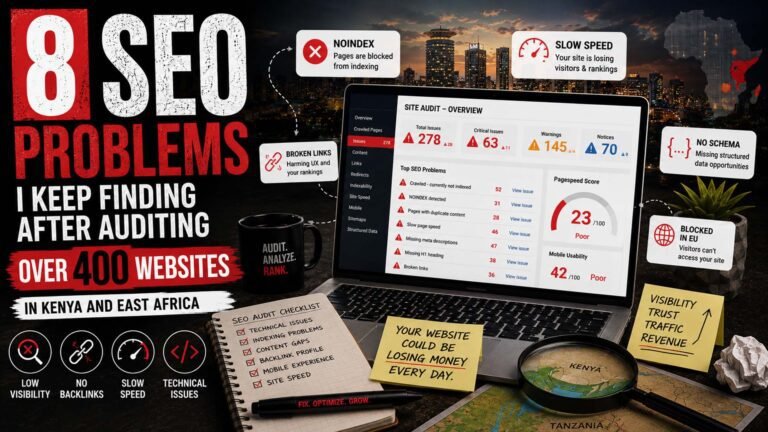
I have audited hundreds of websites across Kenya, Tanzania, Uganda, and East Africa broadly. Law firms in Westlands. Safari companies in Arusha. Hotels in Zanzibar. Clinics in Mombasa. E-commerce stores in Nairobi’s CBD. And I can tell you with complete confidence that the problems I find on a WooCommerce store selling furniture are nothing like the problems I find on a tour operator’s website that is trying to rank for competitive international travel keywords.
Different websites. Different problems. Different amounts of work required to fix them. And therefore, inevitably, different costs.
That is the honest starting point for any conversation about SEO pricing in Kenya.
Why SEO Costs Are Lower in Kenya Than the US or India
Kenya is a middle-income country. The cost of skilled labour is lower here than in the United States, the United Kingdom, or even India. That is a fact, and it works in your favour as a business hiring an SEO agency in Kenya.
A Nairobi-based SEO specialist with genuine expertise will charge significantly less than an equivalent specialist in San Francisco or London. That gap is real and it is one of the legitimate advantages of working with a local agency.
But here is where it gets complicated.
Many businesses in Kenya assume that lower cost automatically means good value. And many agencies in Kenya price their services based on what the market will bear rather than what the work actually requires. Those two things are not the same, and the gap between them is where budgets go to die.
The Local Knowledge Problem That Nobody Talks About
When a business in the US or India pitches you SEO services for your safari company or boutique hotel, they are working from a generic playbook. They know how to build links. They know how to write content. They understand technical SEO. What they do not understand is your niche.
I have spent years working with tour operators and hotels across East Africa. Roy Safaris. The African Tulip. Trek Safaris Uganda. That experience taught me something that no amount of generic SEO training covers.
When you are doing SEO for a tour company or a hotel in Kenya, the content that actually builds topical authority is not the content that sounds impressive in a pitch deck. It is the specific, granular, locally informed content that mainstream travel media has not yet touched.
The hidden crater lake in the Aberdares that only locals know about. The specific tree in the Mara that has been used as a landmark by Maasai guides for generations. The exact migration patterns that determine which month delivers the best game viewing in which specific region of the Serengeti.
When you publish content covering these things accurately and with genuine local insight, you build topical authority in a way that a content writer in Mumbai or Dallas simply cannot replicate, no matter how good their English is or how many keyword tools they use.
Now, should you also eventually write “Traveling to Kenya: The Ultimate Guide”? Yes. At some point you should. Not because it is going to rank immediately. Not because it will drive traffic in year one. But because topical authority requires coverage of the broad topic alongside the specific ones. You are not going to own the topical map of Kenyan safari travel if you only write about hidden gems and skip the obvious pillars. Cover it for completeness. Just do not expect it to rank quickly if your website is new or has limited authority. The sites ranking for that keyword have years of history and thousands of backlinks. You earn the right to compete for it over time.
Why SEO for Tour Companies and Hotels Cannot Be Cheap
Here is the part that most agencies will not tell you before they take your money.
Travel and hospitality SEO in East Africa is one of the most competitive niches on the internet. You are not competing with other Kenyan agencies. You are competing with international travel publishers, major OTAs, and safari companies that have been investing in SEO for over a decade.
Asilia Africa has backlinks from the Guardian. Yellow Zebra Safaris appears in Condé Nast Traveller. &Beyond gets coverage from the BBC. These are not just well-known publications. These are some of the highest-authority websites on the internet. A single link from the Guardian carries more SEO weight than a hundred links from local Kenyan directories.
And here is the part that should make you rethink that Ksh 30,000 per month proposal you just received.
A quality backlink in the travel and hospitality niche costs anywhere from $100 to $200 per link. That is Ksh 13,000 to Ksh 26,000. Per link. A single one.
To put that in perspective, $200 is roughly equivalent to a full month’s salary for many Kenyans. And building genuine authority in competitive travel SEO requires acquiring multiple quality links every single month over an extended period, while simultaneously producing high-quality, locally informed content, maintaining technical SEO health, and managing the ongoing optimisation of your existing pages.
Now ask yourself: what is an agency actually doing for Ksh 35,000 per month?
I will tell you what they are doing. They are sending you a monthly report. They are tweaking a few meta descriptions. They are maybe posting a blog article that they wrote with AI in twenty minutes. They are keeping your Google Search Console connected and calling that monitoring. None of those things are going to move you from page four to page one for a competitive keyword in the safari or hospitality space.
You are paying for the appearance of SEO, not for SEO.
What You Should Actually Consider Before Paying for SEO
Before you hand over any amount of money to an SEO agency in Kenya, there are four things worth examining carefully.
Niche expertise. Has the person or agency you are considering actually worked in your industry before? Not worked on websites generally. Worked in your specific niche. A tour company needs an SEO specialist who understands travel intent, who knows the difference between a luxury safari client and a budget backpacker, who has spent time looking at how international travel audiences search. Ask for examples. Ask for case studies. Ask which tour companies or hotels they have worked with and what the outcomes were.
Writing quality. SEO content for travel and hospitality is not the same as writing a generic blog post about digital marketing tips. It requires depth, accuracy, and local knowledge. Ask to see actual writing samples from their travel or hospitality work. If the writing is generic, keyword-stuffed, or could have been produced by someone who has never been to Kenya, the content they produce for you will reflect that.
Web design and technical skills. A tour company or hotel website has specific conversion requirements. A trip inquiry form that loads slowly on mobile loses bookings. A gallery that breaks on certain devices loses trust. An SEO specialist who only understands content but cannot assess your site’s technical performance is only solving half the problem.
Modern SEO and AEO expertise. The landscape has changed significantly. A specialist who is still operating from a 2019 SEO playbook is not equipped to handle the realities of 2026, which includes Google AI Overviews appearing at the top of search results, answer engine optimisation for platforms like ChatGPT and Gemini, entity-based SEO, and schema markup that communicates directly with AI systems. Ask what they know about generative engine optimisation and how they approach AI search visibility. If they look confused, that tells you something important.
So How Much Should You Actually Pay?
This is the question I get asked more than any other. And my answer is always the same, which either reassures people or frustrates them depending on what they were hoping to hear.
It depends on your niche’s competitiveness.
A local bakery in Nakuru competing for “cakes Nakuru” is in a completely different competitive environment from a safari company in Nairobi competing for “luxury Tanzania safari.” The bakery might achieve meaningful results from a Ksh 50,000 per month programme. The safari company might need three to four times that, and even then needs to enter the engagement with realistic expectations about timeline.
Here is a rough framework for thinking about it.
Low competition niches, meaning local service businesses in smaller Kenyan cities targeting local customers, can work with Ksh 40,000 to Ksh 60,000 per month from a good agency. You will see results in four to six months.
Medium competition niches, meaning professional services in Nairobi, retail ecommerce, and businesses competing nationally, typically need Ksh 70,000 to Ksh 120,000 per month for a programme that includes content production and genuine link building.
High competition niches, meaning safari and tour operators competing internationally, luxury hotels targeting UK and US markets, real estate developers competing with international platforms, and legal services in Nairobi’s most competitive practice areas, should expect to invest Ksh 150,000 per month and above for a serious programme. And they should expect it to take twelve to eighteen months before they see the kind of rankings that justify that investment.
None of those numbers guarantee results. What they represent is the minimum investment required to do the work that results actually require. Below those thresholds, you are paying for reports. Above them, you are paying for work.
The most expensive thing you can do in SEO is pay a cheap agency for two years and then start over with a competent one. You have lost the time, the budget, and sometimes the trust signals from a site that accumulated bad links or thin content in the process.
Spend well from the beginning. Understand what your niche actually requires. And ask hard questions before you sign anything.
If you want an honest assessment of what SEO for your specific business in Kenya would actually require, that is exactly the kind of conversation we have at SEO Agency Kenya. We will not tell you what you want to hear. We will tell you what the data says.